The Dr MCR HRD Institute conducted a “Training Program on Implementation and Monitoring of Sustainable Development Goals (SDGs)”, sponsored by DoPT, Government of India. The Program was attended by senior Indian Administrative Service (IAS) Officers and All India Services (AIS) Officers from Ministry of Health &Family Welfare, Ministry of Defence, Ministry of Finance, Ministry of Home Affairs, etc., from across the country.
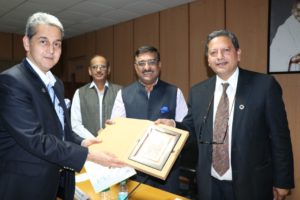
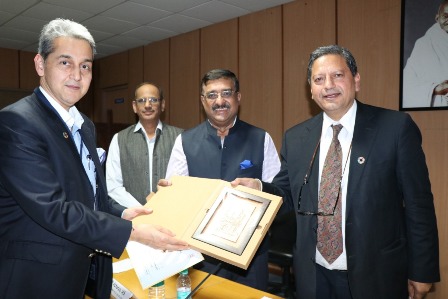
The Sanjeev Chopra, IAS, Director, Lal Bahadur Shastri National Academy of Administration (LBSNAA), Mussoorie,who was the chief guest at the valedictory function, gave away participation certificates to the officers.
The Sanjeev Chopra, in his keynote address, said thatthe planning, strategy formulation, and decision makingfor overall development should be evidence-based witha broader focus. “Had there been scientific planning in farming, Punjab would not have encountered the problems of huge surplus of wheat and rice, which brought in its wake multiple problems for farmers”, he stated and added that the model of development with a singular focus on rice and wheat, at the cost of other crops, does not fit into the framework of sustainable development.
Continuing his address, he said that in order to achieve sustainable development, an equi-focus on both agriculture and industry is a sine qua non. “Developing only one sector, at the cost of other equally important sectors, is not the right strategy as all sectors is inter-connected”, he observed.
“While Allopathic system of medicine has got its own merits, a singular focus on its development is not the right approach in addressing the health issues of India”,Sri Sanjeev Chopra opined. Citing the example of China, which earmarks a huge budget for the development of its traditional systems of medicine, he called for the need for the development of home grown systems of medicine, namely, Ayurveda, Homeopathy, and Unani.
Sri Sanjeev Choprastated that ready access to modern technologies has made it possible not only to identify, in advance, the incidence of such problems as poverty, hunger, malnourishment, etc. but also to find enduring solutions to them.
The B P Acharya, IAS, Ex Officio Spl. Chief Secretary& DG, Dr. MCR HRD Institute, said that the training program on SDGs for senior IAS & AIS officersis a first-of-its-kind initiative in India. “Enlightening and empowering the leadership at top rungs of administrative hierarchy will be greatly instrumental in giving a big boost to successful implementation of SDGs and also in ameliorating the lot of weaker sections of society”, he stated. “Framing simple metricsfor the concurrent monitoring of the implementation of the SDGs, rather than complicating the whole issue by using complex systems, is the need of the hour”, he added. Divya Parmar, IES, Course Coordinator proposed a vote of thanks.